



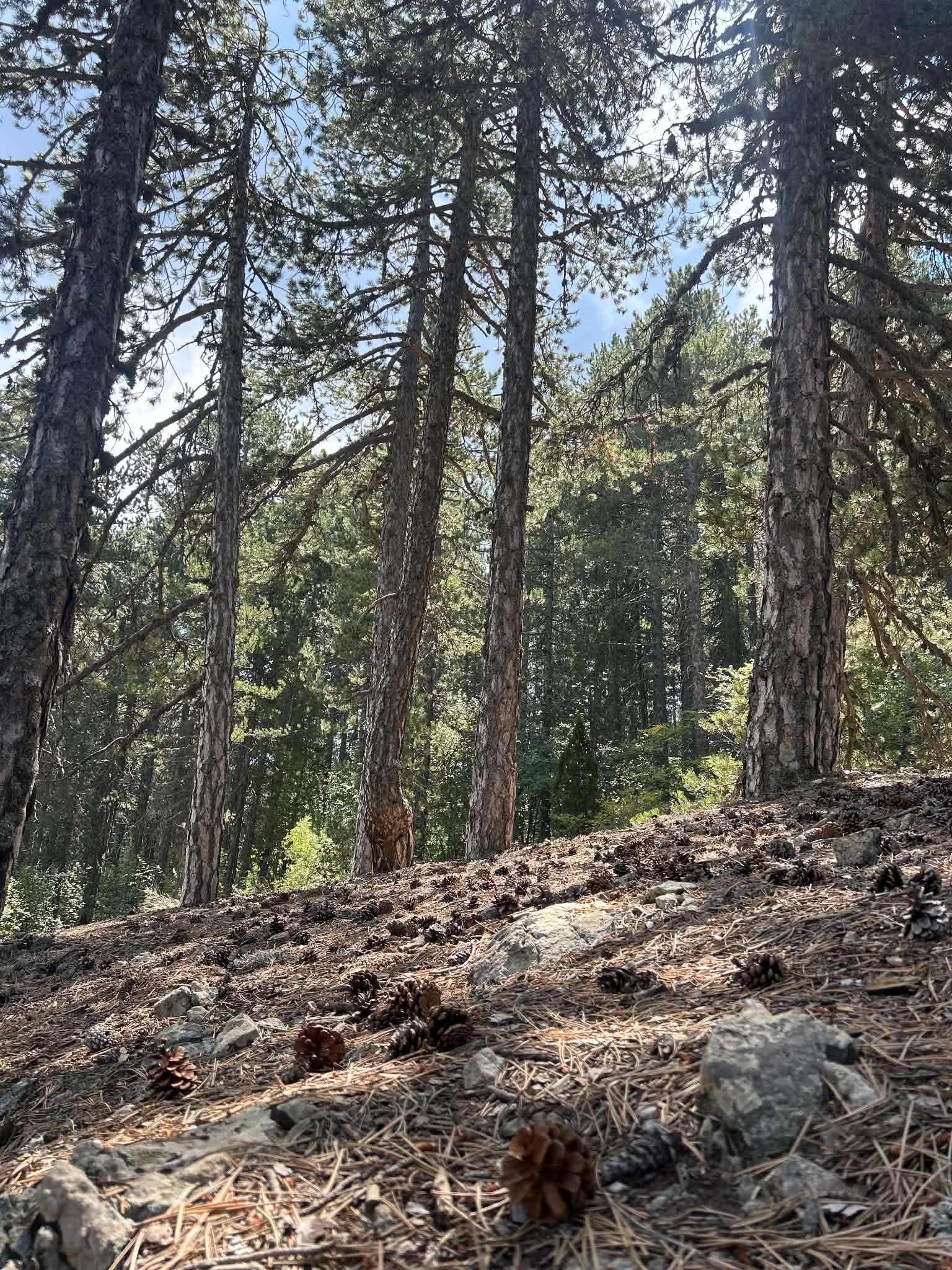
The Troodos Mountains are more than Cyprus’ green heart. Their geology, water, forests and villages have played a much bigger role in shaping the island than their spectacular scenery alone might suggest.
For many visitors, the Troodos Mountains represent a different side of Cyprus: pine forests instead of beaches, mountain villages instead of resorts, and cooler air instead of the heat of the coast.
But there is much more beneath the surface.
Troodos is one of the most unusual mountain landscapes in the eastern Mediterranean. Its rocks tell the story of ancient oceanic crust, its forests shelter a remarkable concentration of endemic species, and its water helped determine where communities could settle. Its mountains also became home to vineyards, monasteries, traditional villages and some of the island’s most important cultural monuments.
Here are five things that reveal a different side of the Troodos Mountains in Cyprus.
1. Troodos Is a Piece of Ancient Ocean Floor
Perhaps the most surprising fact about Troodos is geological rather than geographical.
The mountain range is part of the Troodos Ophiolite, an exceptionally well-preserved fragment of oceanic crust and upper mantle. Geological evidence indicates that the rocks formed around 90 million years ago, at a time when they were part of an oceanic environment. Over millions of years, geological processes uplifted them until they became exposed above sea level. UNESCO describes the Troodos ophiolite as a 90-million-year-old fragment of oceanic crust and highlights its exceptional preservation.
In practical terms, this means that a drive through the Troodos landscape is also a journey through an extraordinary piece of Earth’s geological history.
The unusual rocks are not simply a scientific curiosity, either. Their composition has influenced the landscape, soils, water systems and mineral resources of the region.
It is one reason the Troodos Mountains look and feel so different from many of the surrounding landscapes of Cyprus.
2. More Than a Third of Cyprus’ Endemic Species Can Be Found Here
The Troodos Mountains are also an important centre of Cyprus’ biodiversity.
According to the Geological Survey Department, Cyprus has 142 endemic species, with more than a third found in Troodos at elevations above 1,000 metres. The combination of altitude, geology, rainfall and soil conditions has created habitats in which distinctive plant communities can thrive.
That gives the mountains an ecological significance that goes well beyond their forests.
At higher elevations, the environment becomes almost semi-alpine, with conditions that differ considerably from those found across much of the island. Troodos is also home to extensive woodland and a variety of habitats that support plants and wildlife adapted to mountain conditions.
The effect is particularly noticeable as you gain altitude. Cyprus may be known internationally for its dry Mediterranean climate, but in Troodos the landscape can become considerably cooler, greener and wetter.
This contrast is one of the reasons the mountains have long provided an important escape from the heat of the lowlands.
3. The Mountains Helped Decide Where People Lived
It is easy to think of water as something that simply appears from a spring or tap. In Troodos, however, water has played a much deeper role in the history of settlement.
The fractured rocks of the Troodos range allow water to move deep underground. According to Cyprus’ Geological Survey Department, this process created significant aquifers that discharge through natural springs at different elevations. These springs were an important factor in the development of settlements both in antiquity and in more recent periods.
In other words, the physical structure of the mountains helped shape the human geography of the region.
Villages developed around sources of water, while the availability of fertile soils and a relatively wetter mountain environment supported agriculture and forestry. The same geological processes that make Troodos fascinating to scientists therefore also helped create the human landscape visitors encounter today.
This is one of the more interesting ways to look at the mountain villages: not simply as picturesque places built among the hills, but as communities whose locations were influenced by the natural systems of the range.
4. Ten Troodos Churches Are on the UNESCO World Heritage List
The mountains are equally significant from a cultural perspective.
The Troodos region contains 10 painted Byzantine-era churches and monasteries listed as a UNESCO World Heritage Site. Together, they represent an exceptional collection of religious art and architecture, with murals spanning centuries of Byzantine and post-Byzantine artistic tradition.
What makes them particularly distinctive is their setting.
Many are relatively modest rural buildings on the outside, often characterised by steep-pitched wooden roofs. Inside, however, they contain richly painted walls, icons and frescoes. UNESCO notes that the architecture reflects the geography, history and climate of Cyprus, while the murals demonstrate artistic influences that developed over approximately 500 years.
The ten churches are spread across areas including Pitsilia, Solea and Marathasa, encouraging visitors to explore villages and mountain roads rather than treating the churches as isolated attractions.
This combination of landscape and heritage is part of what makes Troodos unusual. In other parts of Europe, Byzantine churches can feel like individual monuments. Here, they form part of a wider mountain landscape that still contains many of the communities and traditions around which they developed.
5. The Troodos Mountains Helped Make Cyprus a Copper Island
Cyprus’ connection with copper is so deep that the island’s name became associated with the metal itself.
The Mines and Quarries Service states that copper production in Cyprus began on a substantial scale around 3000 BC, and that ancient Cypriots developed sophisticated mining and metallurgical techniques. Many of the copper deposits exploited in modern times had already been identified by ancient miners.
The geology of Troodos is central to this story.
The mineral deposits are associated with the Troodos Ophiolite, with copper and other ores brought closer to the surface through the geological processes that shaped the mountain range. Cyprus’ Geological Survey Department notes evidence of extensive ancient copper production, including archaeological remains, mining galleries, tools and large quantities of ancient slag.
That means the mountains were not simply a source of beauty or agricultural land.
They were an economic resource.
For thousands of years, the minerals beneath the Troodos landscape helped connect Cyprus with wider trading networks and contributed to the island’s importance in the ancient eastern Mediterranean. More recent government information continues to describe Cyprus as one of the earliest places where copper was exploited, processed and used.
A Mountain Range That Explains More of Cyprus Than You Might Expect
Taken together, these five stories change the way the Troodos Mountains can be understood.
They are not simply the highest part of Cyprus or a scenic destination for a day in the countryside.
Their ancient geology influenced the minerals beneath the island. Those geological processes also shaped its water systems and soils. The resulting environment created habitats for endemic plants and supported forests and agriculture. Water and natural resources influenced settlement, while the mountains became home to villages, vineyards, monasteries and churches that remain part of Cyprus’ cultural identity today.
Even the region’s wine culture is tied to its geography. The southern slopes of Troodos are home to long-established wine-producing communities, with several recognised wine routes passing through mountain villages and vineyards at elevated altitudes. In the Pitsilia region, for example, altitude and the sloping, relatively dry terrain influence grape-growing conditions.
Seen this way, Troodos is less a backdrop to Cyprus and more one of the forces that helped shape it.
The next time the mountain roads lead into the pine forests, there is more to see than the view.
There is an ancient ocean beneath your feet, a remarkable concentration of endemic life around you, water moving through rocks below the surface, centuries of religious history in the villages — and traces of an industry that helped give Cyprus part of its historic identity.
Together, these layers make Troodos one of the most revealing landscapes in Cyprus.